
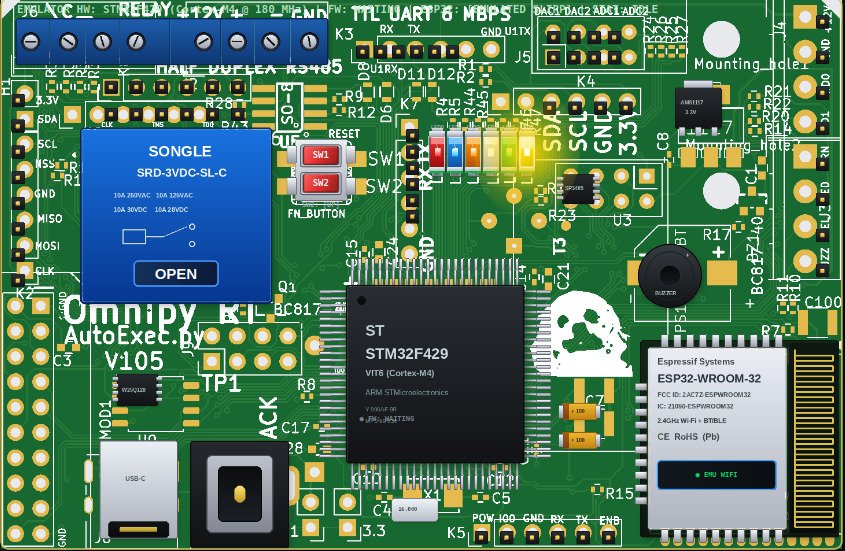
OmniPy STM32F429 Wireless MicroPython IoT Platform & True QEMU Emulator
Developed over 3 years of intensive embedded engineering, the OmniPy Board lets you push and run changeable MicroPython scripts directly on an STM32F429 (ARM Cortex-M4 @ 180MHz) paired with an onboard ESP32-WROOM-32 Wi-Fi module. Execute scripts from volatile RAM for rapid snippet testing or from non-volatile Flash so your application auto-executes on every power-up.
📲 True Hardware-Level QEMU Emulator (Light & Dark Themes)
OmniPy includes a free companion QEMU / NDK C++ Android Emulator (shown below in both Light Theme and Dark Theme). Unlike simple UI mockups, this is a true instruction-level hardware emulator engineered with:
- Internal Model of ESP32 Wi-Fi AT over Serial Port: Faithfully models the onboard ESP32 Wi-Fi AT controller communicating directly with the emulated STM32F429 via internal serial port (UART)—reproducing the exact hardware communication path, IP socket server (port
15555), and UDP broadcast beacon (port15556) of the physical PCB. - Remote JTAG & GDB Step-Through Debugging: Full support for remote JTAG debugging over TCP. Developers and students can program, flash, and run GDB step-debug remotely without buying real hardware—enabling a complete, end-to-end test of any STM32 application before deploying to silicon.
- Interactive Virtual PCB & Live Android Sensors: Toggle and monitor the virtual Songle Relay (
OPEN/CLOSED), Buzzer, user switchSW1 (PA8), hardwareRESET (NRST), I2C 1602 display, and virtual IMU9250 (which reads your Android phone’s real accelerometer and gyroscope).
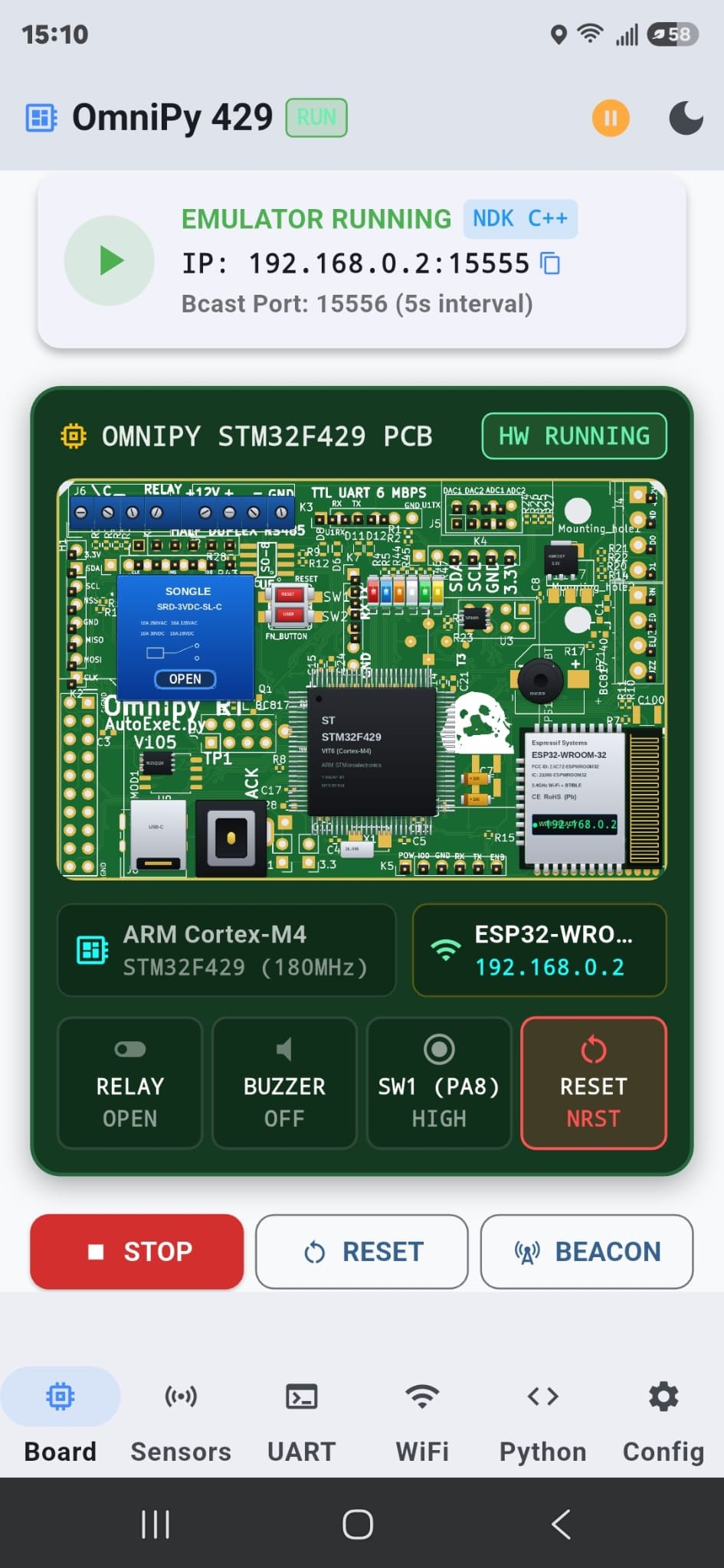
☀️ OmniPy 429 Emulator — Light Theme
Shows the NDK C++ emulator running at 192.168.0.2:15555 with the interactive STM32F429 (180MHz) PCB, internal ESP32-WROOM-32 Wi-Fi AT serial model, Relay, Buzzer, SW1, NRST, and Board/Sensors/UART/WiFi/Python/Config tabs.
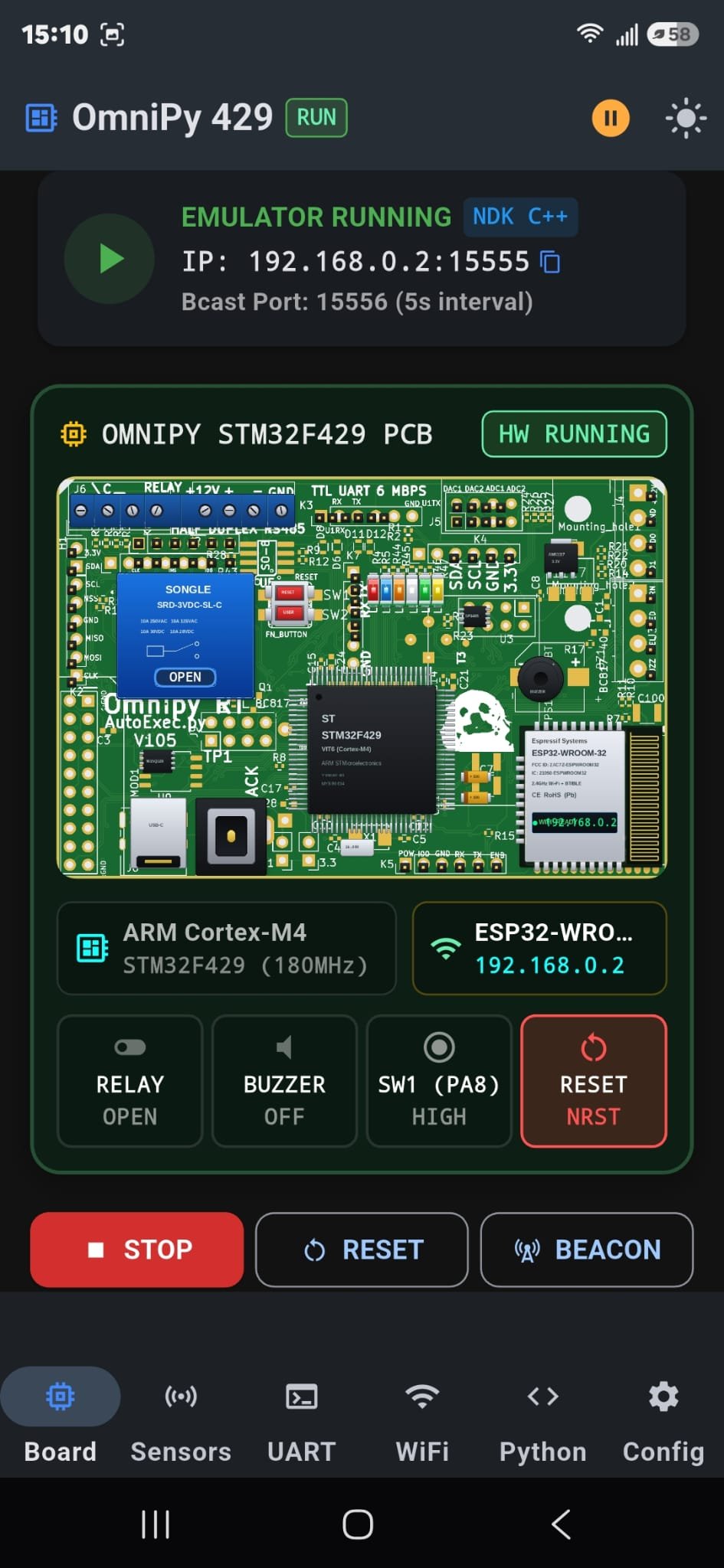
🌙 OmniPy 429 Emulator — Dark Theme
Dark-mode engineering interface for low-glare lab sessions—supporting remote JTAG / GDB step-through debugging so you can program and test full STM32 firmware applications without physical hardware.
(1) OmniPy Hardware Controller App communicates with the physical OmniPy board, while (2) OmniPy QEMU Emulator App emulates the board virtually. Because both apps use the same network port, please do not run them on the same Android device simultaneously.
🔌 Physical Hardware Capabilities
- Wire-Free Protocols over Wi-Fi: Master I2C, high-speed SPI, UART (up to 6 Mbps), GPIO, half-duplex RS-485, onboard power Relay, and Wiegand RFID reader interface.
- FLIR Lepton Night-Vision & Sensor Library: Dedicated header for FLIR Lepton thermal cameras plus growing libraries for IMU9250 9-DoF motion, MLX90640 thermal array, humidity, and millimeter-wave human presence sensors.
- Built-In 12-Bit ADC & DAC: Generate arbitrary/random analog waveforms and capture sensor signals using the STM32F429’s internal ADC and DAC channels.
- Dual Flashing & Field OTA: Program via standard STLink or the 1×6 JTAG connector, and perform wireless Over-The-Air (OTA) firmware upgrades in the field via the Android app.
Reviews
There are no reviews yet.