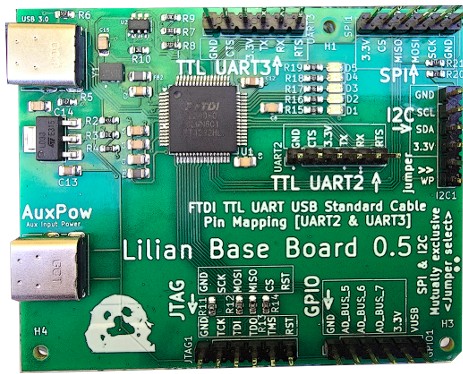
What is Lilian board ?
The Lilian board’s role is to acts as a bridge between an Android device and external sensors, facilitating communication through I2C, SPI, UART, or GPIO protocols over a high-speed USB connection. This all-in-one Lilian board solution is built for simplicity and completeness. Essentially, it needs only following three primary components to function and communicate with electronic sensors of choice:
a. The electronic sensor (for example, a temperature or humidity sensor) with wiring to connect it to the board
b. The Lilian hardware board
c. An Android device with Lilian app installed.
We will use the I2C protocol as our baseline example for two main reasons. First, it is the most sensor supports i2c communication standard and second, it offers simple and easy interconnection.
The I2Cprotocol facilitates communication between two entities: a master and a slave. The master controls all data transactions, while the slave responds according to the I2C specification. In this configuration, the Lilian board operates as the I2C master, and a Python script embedded within the Android application orchestrates the I2C operation sequence.
Leave a Reply